

14/05/2013 - Turkey in World Politics
Dr Nazli Cagin Bilgili (Istanbul Kultur University) and Dr Muzaffer Senel (Istanbul Sehir University) shared a round-table discussion on changes in Turkish domestic and foreign policies.Dr Bilgili focused mainly on the polarization of Turkish domestic politics and society, which can be observed since the religious Justice and Development Party (AKP) came to power in 2002. She also presented an update on the headscarf issue, arguing that it continues to be an unresolved legal matter for women in public offices despite the religious government lifting the ban on wearing the headscarf in Turkish universities. Dr Senel focused on Turkey’s external relations arguing that Turkey has reinterpreted its political geography and its strategic objectives after 2002 when neighbors no longer represented enemies but friends and/or prospective economic partners. Dr Senel emphasized that Turkey is involved in many international aid development projects in Africa and South-East Asia as well as in peacekeeping missions in Iraq and Afghanistan, which well illustrate Turkey’s dynamic foreign policy. Dr Senel presented Turkey as a newly self-confident regional power aiming to become a global power whereby participants of the round-table discussed limits to this multidimensional and overstretched foreign policy.
 Photo Gallery
Nazl? Ça??n Bilgili received a B.S. in Political Science and International Relations from Bo?aziçi University in 2004 and a Ph.D. in Political Science from Sabanc? University in February 2011. The title of her dissertation is “Religiosity and Democratic Attitudes: An Empirical Study on Tolerance in Turkey”. She has taken part in several empirical research projects on the role of institutional and social Islam in Turkey. Her publications include scholarly articles and book chapters on Alevi minority in Turkey and female representation in politics. She is currently working as an Assistant Professor in ?stanbul Kültür University.
Muzaffer Senel is a lecturer at Istanbul Şehir University, Department of Political Science and International Relations and serving as vice-director for Center for Modern Turkish Studies. He studied B.A. at Near East University, Cyprus, MA in European Union Institute of Marmara University, and continued Ph.D. at Department of Political Science and International Relations of Marmara University. As a visiting scholar, he has been in various countries, i.e. Hungary (Hungarian Academy of International Affairs), Poland (Jagiellonian University), and the UK (Oxford University, Centre for Islamic Studies). His interest area is the European Union and its foreign policy toward the Middle East, Cyprus, and Turkish Foreign Policy.
Aktuálně
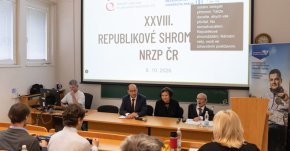 Metropolitní univerzita Praha hostí 28. republikové shromáždění NRZP ČR
8. 10. 2026 Autor: redakce
Je nám potěšením, že Metropolitní univerzita Praha spolupořádá ve svých prostorách 28. republikové shromáždění Národní rady osob se zdravotním postižením ČR (NRZP ČR).
Metropolitní univerzita Praha hostí 28. republikové shromáždění NRZP ČR
8. 10. 2026 Autor: redakce
Je nám potěšením, že Metropolitní univerzita Praha spolupořádá ve svých prostorách 28. republikové shromáždění Národní rady osob se zdravotním postižením ČR (NRZP ČR).
 Studenti MUP s Miss World a příšerkami vyráží do škol zlepšit finanční gramotnost
7. 10. 2026 Autor: Dominik Stroukal
Jak zábavnou formou přiblížit dětem a mladým lidem svět financí? O to se snaží vzdělávací aplikace Money Monsters, za kterou stojí ekonom a garant studijního programu Digitální ekonomika na MUP dr. Dominik Stroukal a Miss World Krystyna Pyszková.
Studenti MUP s Miss World a příšerkami vyráží do škol zlepšit finanční gramotnost
7. 10. 2026 Autor: Dominik Stroukal
Jak zábavnou formou přiblížit dětem a mladým lidem svět financí? O to se snaží vzdělávací aplikace Money Monsters, za kterou stojí ekonom a garant studijního programu Digitální ekonomika na MUP dr. Dominik Stroukal a Miss World Krystyna Pyszková.
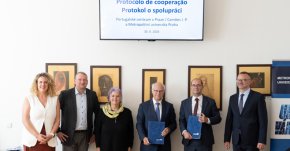 Portugalštinu na MUP podpoří institut Camões
1. 10. 2026 Autor: Jan Haňka
Na MUP máme další důvod říct „olá“! Ve středu 30. září 2026 bylo na Metropolitní univerzitě Praha podepsáno memorandum o spolupráci s institutem Camões. Přinese podporu výuky portugalštiny i příležitosti poznávat kultury portugalsky mluvících zemí. Slavnostní setkání přitom provázela výborná nálada a velmi přátelská atmosféra.
Portugalštinu na MUP podpoří institut Camões
1. 10. 2026 Autor: Jan Haňka
Na MUP máme další důvod říct „olá“! Ve středu 30. září 2026 bylo na Metropolitní univerzitě Praha podepsáno memorandum o spolupráci s institutem Camões. Přinese podporu výuky portugalštiny i příležitosti poznávat kultury portugalsky mluvících zemí. Slavnostní setkání přitom provázela výborná nálada a velmi přátelská atmosféra.