

Digital Extremism and Emerging Threats: Insights from Expert Lectures at MUP
5. 5. 2026 Author: Oldřich Bureš In April 2026, the Center for Security Studies and the Department of International Relations and European Studies at Metropolitan University Prague hosted thought-provoking lectures examining the evolving landscape of violent extremism. Delivered by Sean McCafferty and Adam Hanzel, both Marie Skłodowska-Curie GLOCTER Project PhD fellows, the sessions explored how terrorist actors exploit the digital environment and how new, harder-to-define forms of extremism are reshaping traditional security frameworks. Together, the lectures offered students a comprehensive look at both the online dynamics of contemporary terrorism and the emerging challenges posed by accelerationist and nihilistic violent extremist movements.Terrorist Exploitation of the Internet
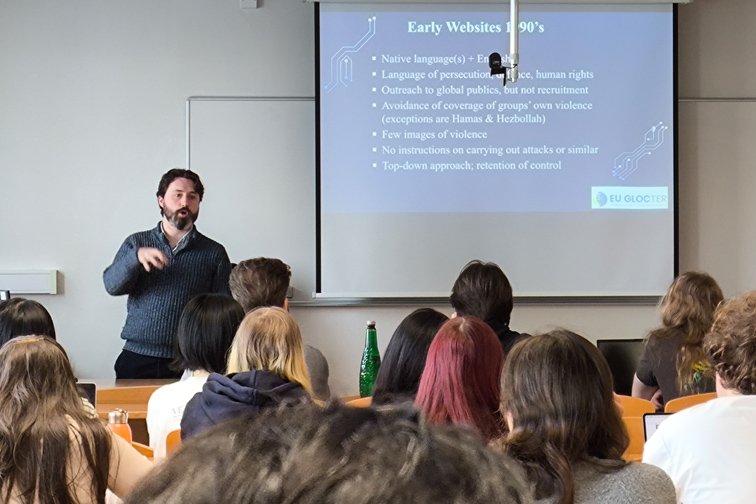
On Tuesday, 14 April, 2026, Sean McCafferty, Marie Skłodowska-Curie GLOCTER Project PhD Fellow at MUP, delivered a double public lecture on "Terrorist Exploitation of the Internet” hosted by the Center for Security Studies and Department of International Relations and European Studies.
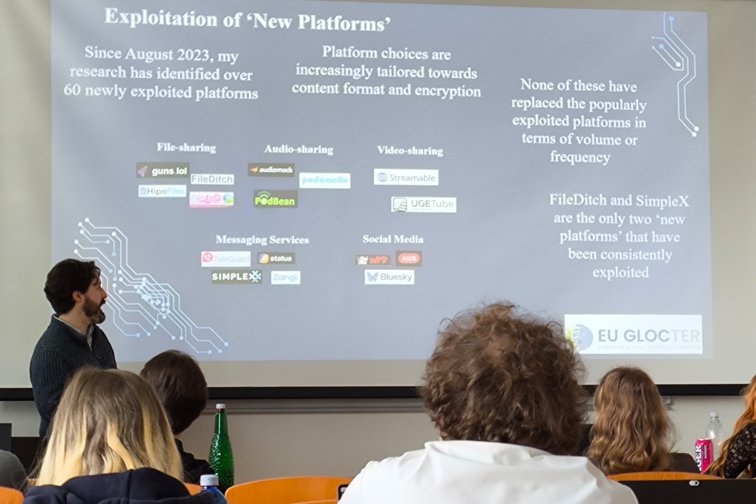
The two-part session introduced students to the ways extremist and terrorist actors exploit online platforms, focusing on dissemination strategies and identifying terrorist content. Students explored emerging trends, such as the surge in terrorist propaganda after the October 7th Hamas attack on Israel, the persistence of extreme right-wing content, and the resurgence of Islamic State (IS) propaganda on mainstream platforms culminating in an interactive workshop.
The second session focused on Islamic State demonstrating the evolution of IS propaganda and community online, with the group adapting its strategies in response to territorial defeats and online content moderation. Students explored the group’s evolving online ecosystem and the recent resurgence of terrorist material on mainstream platforms, likely due to the rollback of content moderation policies. The lecture concluded with a debate on the role of online propaganda in inspiring real-world violence, encouraging students to consider the root causes of these phenomena.
Is Accelerationist Nihilistic Violent Extremism a Fifth Wave of Terrorism?
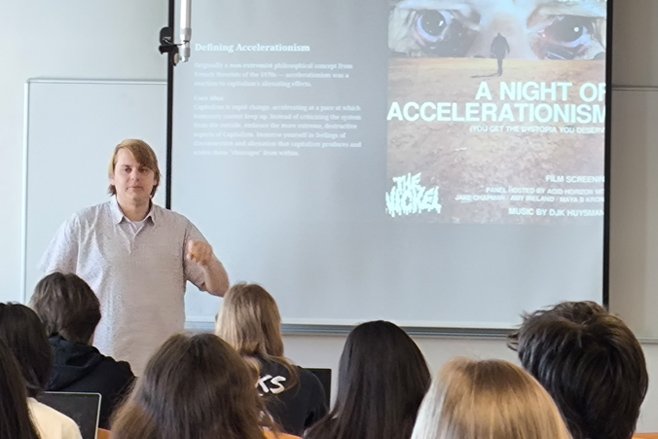
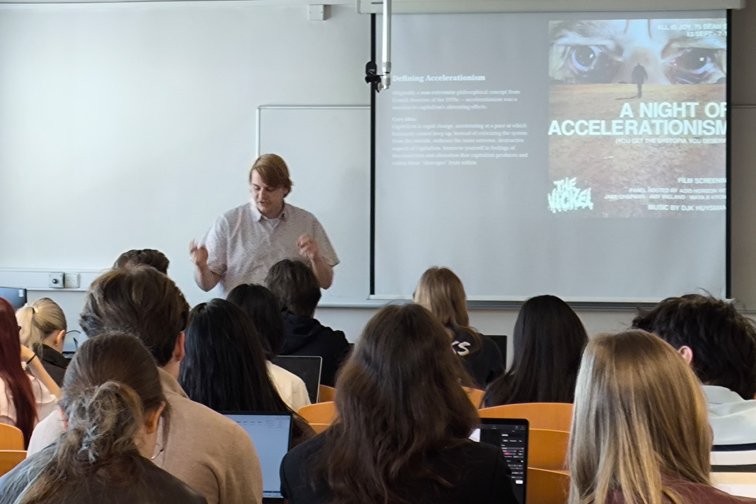
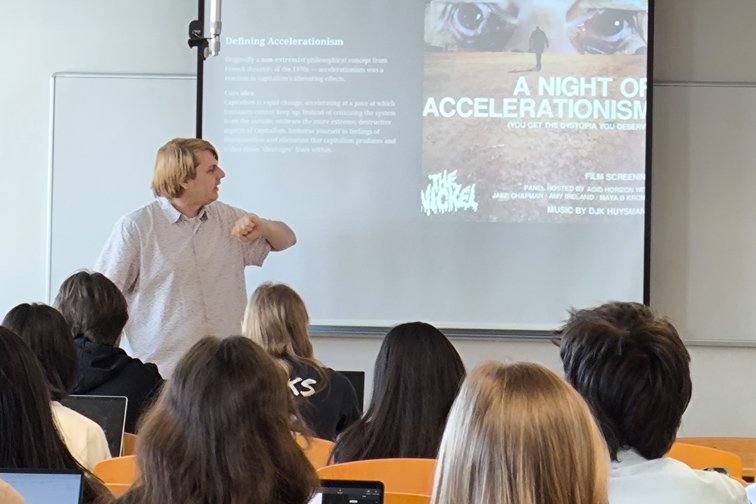
On April 28th, 2026, Adam Hanzel, Marie Skłodowska-Curie GLOCTER Project PhD Fellow at MUP led a lecture for MUP undergraduates and the wider MUP community on accelerationism and nihilistic violent extremism (NVE). The event was hosted by the Center for Security Studies and Department of International Relations and European Studies.
Since 2021, we have seen an unprecedented uptick in indiscriminate violence across Europe, where violence is glorified for violence’s sake. The lecture focused on how we may approach NVEs as multifaceted threats that challenge conventional definitions of extremism and existing counterterrorism frameworks. Students were introduced to NVEs, how we may address them using common frameworks, and how identity fusion theory may be our best option for such groups going forward.
Beginning with the case study of 764, COM, and related NVE groups, the lecture first described the philosophy of NVE groups. At their core is accelerationism, a philosophy that promotes the collapse of the system from within to establish a new order. The “system” for accelerationism, in its development in the 1970s, was capitalism, but the philosophy has been co-opted by NVEs seeking to collapse liberal democracy. They are also “nihilistic” in that they mobilize and promote physical manifestations of philosophical nihilism and aesthetic nihilism.
The discussion then turned to whether our current terrorism and counterterrorism frameworks were applicable for defining and addressing such threats. With the hyper-local acts conducted or provoked by NVEs, and their marked decentralized nature, it is difficult to neatly place NVEs squarely as terrorist actors. This is evident in how indictments of these individuals are vague in their own definitions, if not contradictory.
However, there has been a continual shift towards looking at and defining terrorism as a social construction. Thought in this way, frameworks such as identity fusion theory, as Adam points out, may be the best way to address these evolving threats that have ideology as a secondary thought. In the case of NVEs, social identity is shaped through grievances of alienation that are themselves amplified by decentralized networks. When these identities are threatened by social norms, including those prohibiting violence, then these individuals act in those ways and glorify those practices. Accelerationist thinking increases these feelings of hatred, perceived societal hostility, and perceived impact of their actions.
Other items from the/this section
 International Staff Week in Sarajevo
Last week, our colleagues from the International Office participated in the International Staff Week hosted by International Burch University in Sarajevo.
International Staff Week in Sarajevo
Last week, our colleagues from the International Office participated in the International Staff Week hosted by International Burch University in Sarajevo.
 Metropolitan University Prague's Fleet Cruised the Waters of the Vltava
How should a university celebrate its twenty-fifth anniversary? What better way to mark the occasion than with a fleet of MUP steamboats cruising along the Vltava, offering panoramic views of Old Prague, Charles Bridge, Vyšehrad and other landmarks? That would certainly be something special. And that is exactly what happened!
Metropolitan University Prague's Fleet Cruised the Waters of the Vltava
How should a university celebrate its twenty-fifth anniversary? What better way to mark the occasion than with a fleet of MUP steamboats cruising along the Vltava, offering panoramic views of Old Prague, Charles Bridge, Vyšehrad and other landmarks? That would certainly be something special. And that is exactly what happened!
 Globalization, Illicit Trade, Sustainability and Security COST Action
MUP hosted the Globalization, Illicit Trade, Sustainability and Security (GLITSS) COST Action Final Book Workshop from 18–20 May 2026 at Metropolitan University Prague.
Globalization, Illicit Trade, Sustainability and Security COST Action
MUP hosted the Globalization, Illicit Trade, Sustainability and Security (GLITSS) COST Action Final Book Workshop from 18–20 May 2026 at Metropolitan University Prague.