


Ibero-American Prize: Interview with Successful Participant Lucia Argüellová
3. 4. 2014 Autor: redakce The award ceremony of the XIX edition of the Ibero-American Prize (Premio Iberoamericano) took place in mid-January 2014 at the Charles University. As every year, the recent competition involved students enrolled in bachelor's and master's programs of Czech universities who elaborated their essays in Spanish or Portuguese on topics related to history, politics, economics, culture, art, science, and realities of Latin American countries.The jury composed of leading representatives of embassies of the Iberoamerican countries praised and financially rewarded three students: 1st place went to Klára Kleňhová (University of Hradec Králové), the 2nd place to Lucia Argüellová (Metropolitan University Prague), and the 3rd place to Nicole Marföldi (Charles University).
Since 1994, the representatives of diplomatic missions from Latin American countries, accredited in the Czech Republic, have rewarded best students’ works with attractive prizes. The aim of the competition is to promote research and study of Latin America, the Caribbean and the Iberian Peninsula in the Czech Republic.
The Ibero-American Center of the MUP interviewed Lucia Argüellová, a successful participant of the latest Premio, to gain an insight into her partaking in the competition.
 1. You participated in the prestigious student contest Premio Iberoamericano, where you won an excellent second place. With what essay did you compete?
The title of my essay in Spanish is Tan lejos de Dios, tan cerca de Estados Unidos: Las dinámicas actuales de la migración mexicana a Estados Unidos, which could be translated as So far from God, so close to the United States: current dynamics of Mexican migration to the United States.
2. What drew your interest and attention to Mexico, and especially to the area of the US-Mexican border?
Originally, I was rather interested in Central America due to numerous visits to Costa Rica and Nicaragua during my childhood. However, when the opportunity of a study exchange with a non-EU university emerged, I applied for universities in Mexico and Colombia, which consequently allowed me to spend one year studying at ITESM (Tec de Monterrey) in Mexico. This experience and the knowledge I had acquired during my stay, as well as the long-term cooperation and support from Kateřina Březinová, brought about the opportunity to participate in a project backed by the Czech Ministry of Education that included activities such as development of MUP's Ibero-American Center and my research trip to the US-Mexican border, which tied my attention to the specific region and its issues.
3. In July 2013, you had the opportunity to visit the border between San Diego and Tijuana thanks to the financial support from the internal grant MUP and from the Czech Ministry of Education. How did your expectations differ from the reality you experienced on the border?
I went to SD/TJ to learn more about Mexican migration; particularly, I aimed to complete the picture on undocumented border crossing, detention centres in the USA and effects of deportations in order to see how human security is challenged during migrant’s journey. Prior to the research trip, I went through a number of articles and other publications, NGO websites, governmental reports, documentaries, etc. Hence, my expectations were relatively accurate, but the reality was still disturbing: the personal contact with migrants and their environment was, however, very important and enriching even though sometimes gloomy.
4. The award you received included a financial reward. What will you use it for? What are your future study plans?
On the ceremony eve, Guillermo Federico Kreckler, the chargé d´affaires of the Argentine Republic, gave me an envelope containing 700 USD, which was a bizarre way how to receive an award:) Since I travel to the Americas from time to time, I suppose I will use it to cover initial expenses for travelling and maybe even living in case I end up studying or working there. Currently, I am hoping for completing my MA thesis, graduating myself and thinking about applying for a PhD in Colegio de la Frontera Norte in Tijuana or going for an internship or other working experience.

Other items from the/this section
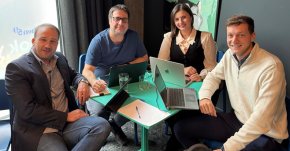 The SMILE Project Enters Its Final Phase: Focus on Practical Outputs and Workshops
The SMILE project, which aims to strengthen leadership skills, digital skills, and media literacy among young people in rural areas of the Danube region, entered its final year this fall.
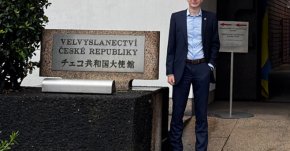 From MUP to the Czech Embassy in Tokyo
12. 11. 2026 Author: Adam Outrata
My name is Adam and I am a student of the 5th semester of my bachelor's degree in International Relations – European Studies. But currently I am an intern at the Embassy of the Czech Republic in Tokyo, Japan, in the commercial and economic section of the embassy. In addition to my studies at MUP, I got this opportunity thanks to an exchange study stay in Denmark at Aarhus University, where I studied Political Science.
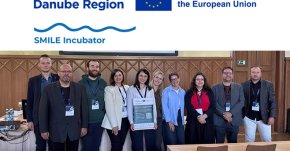 University Representatives and the SMILE Project Team at the CEPSA Anniversary Conference
The prestigious two-day conference organized to mark the 30th anniversary of the Central European Political Science Association (CEPSA) welcomed academics and scholars from all around Europe and the world. This significant event, which is a living proof of successful cross-border academic cooperation, offered a rich program full of panel discussions and round tables on various socioeconomic and political academic papers.