

08/11/2013 - Conference - Connecting Southeast Asia and the World: Cultural, Historical and Political Ties
On November 8th 2013, the Department of Asian Studies and the Center for Asian-Pacific Studies of Metropolitan University in Prague held the 5th annual conference on Southeast Asia entitled Connecting Southeast Asia and the World: Cultural, Historical and Political Ties. This time the panels delved into the cultural and historical connections of Southeast Asia to wider Asia and other continents as well, stressing the new and unique forms that have formed by blending languages, technologies, religions and different philosophical conceptions all brought together by waves of migrants that converged into this particular region via many different trading routes.The morning Nusantara (Insular Southeast Asia) panel was opened by a keynote speech by prof. Edwin Wieringa (Universität zu Köln) who gave a lecture on Islamic comics in Malaysia and Indonesia, explaining the commercialization of this phenomenon and the various messages it can carry. Ian Caldwell (University of Leeds) chose to elaborate on the history of the early states of South Sulawesi, including both textual and archeological evidence. Kevin W. Fogg (Oxford University) then followed with a paper on Islamic Socialism connecting the regions all the way across South Asia and Indonesia. The next speech by Dominik Műller (Goethe-University Franfurt) further explored the “pop”-ization of the Islamic party PAS in Malaysia. The last speaker of this panel, Media Zainul Bahri (Universität zu Köln) spoke on the idea of religious pluralism in Indonesian Theosophical Society in the early 20th century.
In the afternoon, the following panel consisted of four speakers on Vietnam, also focusing on the wider context of the Asian continent. Jérémy Jammes (IRASEC) presented his research on the Cao Dai religion as well as other occult and spiritist groups in Vietnam that gained prominence in the 20th century. The next speech by Pascal Bourdeaux (Ecole française d'Extr?me-orient) focused on the Buddhist revival and cultural interactions in Vietnam also during the first half of the 20th century. The conference was concluded by two papers on Southeast Asian history by Czech researchers: Ján Ičo (Charles University in Prague) in his presentation elaborated on several quasi-historical characters who provide early evidence of Buddhism in Vietnam; and Barbora Jirková (Charles University in Prague) who dealt with the topic of the state and the supernatural in traditional Vietnam, pinpointing many aspects of changing culture throughout the history.
The 5th Prague Conference on Southeast Asian Studies was funded by the RESAREAS project, the cooperation network for research of non-European areas.
 Photo Gallery
Aktuálně
 Co odlišuje terorismus od jiných forem násilí
16. 8. 2026 Autor: redakce
Prof. Oldřich Bureš z Katedry mezinárodních vztahů a evropských studií se zúčastnil zajímavé diskuze, respektive natáčení dílu podcastu 10:35 na téma Co odlišuje terorismus od jiných forem násilí. Společně s Vojtěchem Šimákem a Petrem Mlejnkem byly diskutovány soudobé i historické aspekty terorismu.
Co odlišuje terorismus od jiných forem násilí
16. 8. 2026 Autor: redakce
Prof. Oldřich Bureš z Katedry mezinárodních vztahů a evropských studií se zúčastnil zajímavé diskuze, respektive natáčení dílu podcastu 10:35 na téma Co odlišuje terorismus od jiných forem násilí. Společně s Vojtěchem Šimákem a Petrem Mlejnkem byly diskutovány soudobé i historické aspekty terorismu.
 Elektrizující atmosféra a plný klub: MUP Night zakončila školní rok ve velkém stylu
27. 6. 2026 Autoři: Dominik Borek, Sebastian Szaban
The end of the school year party se uskutečnila v klubu The Pitch a proběhla ve skvělé atmosféře plné hudby, zábavy a dobré nálady.
Elektrizující atmosféra a plný klub: MUP Night zakončila školní rok ve velkém stylu
27. 6. 2026 Autoři: Dominik Borek, Sebastian Szaban
The end of the school year party se uskutečnila v klubu The Pitch a proběhla ve skvělé atmosféře plné hudby, zábavy a dobré nálady.
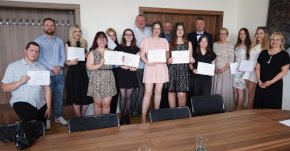 Profesní certifikáty GSA v oblasti marketingu leteckých společností a destinačního managementu
23. 6. 2026 Autor: Nora Dolanská
Slavnostním předáním certifikátů studentům, kteří absolvovali kurz pro General Sales Agenty v oblasti marketingu leteckých společností a destinačního managementu, letos poprvé vyvrcholila doplňková výuka bakalářského i magisterského studia na Katedře cestovního ruchu.
Profesní certifikáty GSA v oblasti marketingu leteckých společností a destinačního managementu
23. 6. 2026 Autor: Nora Dolanská
Slavnostním předáním certifikátů studentům, kteří absolvovali kurz pro General Sales Agenty v oblasti marketingu leteckých společností a destinačního managementu, letos poprvé vyvrcholila doplňková výuka bakalářského i magisterského studia na Katedře cestovního ruchu.