

Populism, Foreign Policy, and a Week of Intense Debate: PhD Summer School at MUP
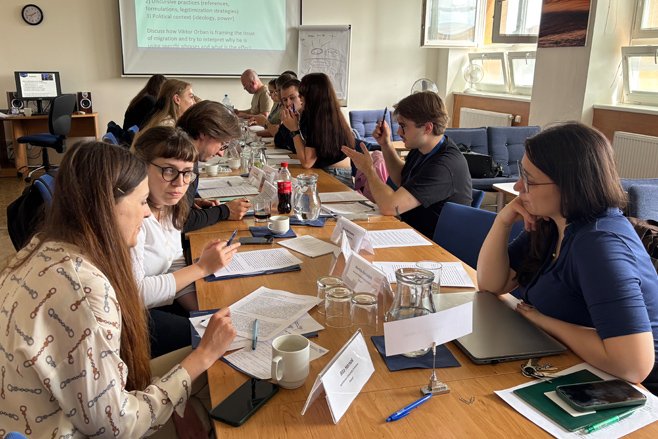
9. 6. 2025 Author: Šárka Kolmašová From June 2 to 6, the Center for Security Studies (C4SS) at Metropolitan University Prague hosted a week-long Doctoral Summer School under the Erasmus+ Blended Intensive Programme (BIP), taking on one of today’s most urgent political questions: How is populism reshaping foreign and security policy in Central and Eastern Europe? The event gathered PhD students from Poland, Slovakia, Lithuania, Portugal, and Bulgaria, each bringing fresh insights and case studies from their own regions. Across five packed days—and two preparatory online sessions—participants dissected narratives, analyzed media, pitched research, and explored publishing strategies with a lineup of top-tier scholars.The school kicked off with two online webinars in May, setting the stage for in-person collaboration. The first introduced key theoretical concepts—populism, post-populism, and foreign policy analysis—alongside an icebreaker where participants met and shared their research angles. The second featured a standout virtual panel with Erin K. Jenne (CEU) and David Cadier (Sciences Po), offering timely reflections on populist foreign policy strategies.
In Prague, the summer school opened with a welcome from Oldřich Bureš, head of C4SS, followed by an orientation led by Šárka Kolmašová, head of the Department of International Relations and European Studies. The first day closed with a keynote lecture by Petr Kratochvíl, who introduced the Horizon Europe project ACTEU and laid out the conceptual gaps in the current literature on populism and trust in democratic institutions.
Over the following days, the programme explored the issue from multiple angles. Jakub Eberle (Charles University) led a seminar on populist narratives and their rhetorical structure, followed by a group workshop applying discourse analysis tools to real-life texts. Wednesday shifted focus to the digital terrain, where Tiago Gomes Lapa (Charles University) examined how platform design reshapes populist messaging. Asya Metodieva (IIR) then focused on disinformation, state control of online content, and the erosion of traditional journalism.
Thursday featured a mix of policy, regional dynamics, and practical skills. Mats Braun (MUP & IIR) unpacked his recent policy paper on populism in the European Parliament, using it to demonstrate how academics can write policy-relevant outputs. A regional panel discussion followed, with contributions from Ana Bojinović Fenko (University of Ljubljana), Burtejin Zorigt (Heinrich-Böll-Stiftung), and Katarzyna Kochlöffel (IIR), who explored how populist actors in Czechia, Hungary, Slovakia, and Slovenia construct foreign policy narratives in times of crisis. The session was moderated by Jacqueline Dufalla, postdoctoral researcher at C4SS and co-organizer of the event.
Later that afternoon, things took a more dynamic turn. Participants engaged in an academic “speed-dating” session, where they had two minutes to pitch their research projects in rotating rounds. This high-energy workshop was designed to help them sharpen their arguments and practice clarity under pressure. Adding even more value, Elsa Tulmets (European University Viadrina) joined the session to provide targeted feedback.
The final day brought it all together. Participants presented their research in two thematic panels, tackling topics such as the geopolitical use of memory politics in Hungarian foreign policy, the role of AI in shaping and resisting populist narratives, and the ideological drivers of populism’s impact on Central and Eastern European diplomacy. Case studies ranged from Moldova’s migration policy to Lithuania’s populist discourse, and from populist opposition to the EU Green Deal to the rise of market-oriented “liberal populism” in Argentina.
To wrap up the week, Aleš Karmazin and Martina Varkočková, editors of CEJISS, led a publishing roundtable, demystifying the peer-review process and advising students on how to get their work into top-tier journals.
This BIP Summer School did more than deepen scholarly insight into populism and foreign policy—it embodied the spirit of international academic collaboration at its best. It bridged theory and practice, fostered critical engagement across disciplines, and created space for genuine exchange between early-career researchers and seasoned experts. As participants collected their certificates and looked back at the group photo taken on the first day, it was clear that the summer school had fulfilled its core objective: to create a vibrant community of emerging and established scholars. Beyond lectures and workshops, the programme fostered meaningful academic exchange, peer learning, and regional collaboration—laying the groundwork for future research partnerships and continued dialogue across borders.
Other items from the/this section
 A new Centre for European Energy Policy and Security
1. 2. 2026 Author: Lukáš Tichý
A new research centre is being established at MUP to complement the Centre for Security Studies and other regionally focused research centres – the Centre for African Studies, the Centre for Middle Eastern Studies and the Centre for Ibero-American Studies. It will operate under the Department of International Relations and European Studies and the leadership of Dr. Lukáš Tichý.
A new Centre for European Energy Policy and Security
1. 2. 2026 Author: Lukáš Tichý
A new research centre is being established at MUP to complement the Centre for Security Studies and other regionally focused research centres – the Centre for African Studies, the Centre for Middle Eastern Studies and the Centre for Ibero-American Studies. It will operate under the Department of International Relations and European Studies and the leadership of Dr. Lukáš Tichý.
 ACCA Qualification Opportunities for MUP Students
18. 12. 2025 Author: Irena Jindřichovská
Metropolitan University Prague hosted guest presentations focused on ACCA professional qualification opportunities for students of economics and management programmes. The presentations were delivered by Dr. Pavel Procházka, Business Relationship Manager at the international professional body ACCA (Association of Chartered Certified Accountants).
ACCA Qualification Opportunities for MUP Students
18. 12. 2025 Author: Irena Jindřichovská
Metropolitan University Prague hosted guest presentations focused on ACCA professional qualification opportunities for students of economics and management programmes. The presentations were delivered by Dr. Pavel Procházka, Business Relationship Manager at the international professional body ACCA (Association of Chartered Certified Accountants).
 Erasmus Day 2025
17. 12. 2025 Author: Martina Fantová
On Friday, 12 December 2025, the MUP International Office organised the Erasmus Day event to inform interested students about all international opportunities available at MUP.
Erasmus Day 2025
17. 12. 2025 Author: Martina Fantová
On Friday, 12 December 2025, the MUP International Office organised the Erasmus Day event to inform interested students about all international opportunities available at MUP.