

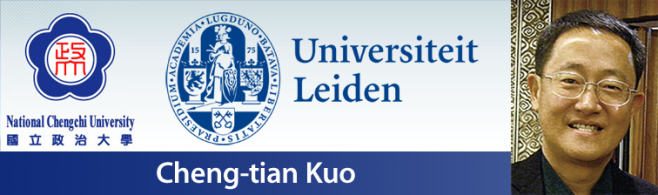
31/03/2016 - New Religious Nationalism in Chinese Societies
The Department of Asian Studies and the Centre for Indo-Pacific Studies have the pleasure to invite you to a special guest lecture of professor Cheng-tian Kuo from Leiden University, the Netherlands, and National Chengchi University, Taiwan, on the topic of New Religious Nationalism in Chinese Societies.WHEN: 31 March 2016, 10:00–11:30
WHERE: MUP Prague-Strašnice building, Dubečská 900/10, room 109
Since the beginning of the 21st century, three models of state-religion relations have taken shape in China, Taiwan and Hong Kong, each would have important implications for both its internal political stability and external political relations. The “rise of China” has been fanatically propelled by a quasi-state religion called “Chinese patriotism.” In Taiwan, a civic religion that promotes checks-and-balances between the state and religion have gradually replaced the state’s dominance over religion. By contrast, state-religion relations in Hong Kong are moving precariously between the Chinese model and the Taiwanese model.
In the past three decades, although “revisionist” scholars have successfully challenged the hitherto dominant school of “modernity” to explain state-religion relations in Chinese societies, they fall short on the prescription of a proper model of state-religion relations. This paper draws from the recent findings of neurotheology to compliment the revisionist interpretations with a normative assessment of proper state-religion relations in Chinese societies.
Taking this revisionist/neurotheological view, the roots of these three models of state-religion relations can be traced to common psychological responses of Chinese intellectuals and politicians to threats of modernity from the late Qing dynasty to the Republican era. After 1949, threats of modernity and, hence, state-religion relations evolved differently in China, Taiwan and Hong Kong due to idiosyncratic domestic and external political relations. In China, the United Fronts strategy of state-religion cooperation was soon replaced by a radical Marxist strategy to eliminate religion from 1957 to 1979. Although liberal reforms since 1979 brought back the United Fronts strategy, a new quasi-state religion of Chinese patriotism has been under construction. In Taiwan, a similar United Fronts strategy of state-religion relations provided political stability to the KMT party-state from 1949 to 1987. However, the initiation and consolidation of democracy after 1987 have contributed to the rise of a civic religion which provides for healthy checks-and-balances relations between the state and religion. In Hong Kong, a strict separation of state and religion was maintained by the British colonial government from 1949 to 1997. But the turnover of sovereignty to the Chinese government after 1997 saw increasing confrontations between the state and religion.
This paper systematically compares these three models of state-religion relations in China, Taiwan and Hong Kong, in terms of their treatments of five critical issues in state-religion relations: (1) state religion, (2) the separation of state and religion, (3) the conflict between national sovereignty and religious sovereignty, (4) the “anti-modernity” of Chinese traditional religions, and (5) the applicability of Western democracy to state-religion relations in Chinese societies.
Cheng-tian Kuo is Taiwanese Chair of Chinese Studies, International Institute for Asian Studies at Leiden University, the Netherlands. He is also Distinguished Professor of Political Science Department and Professor of Graduate Institute of Religious Studies at National Chengchi University, Taiwan. His major expertise includes Christian theology and Asian religious politics. He is the author of Religion and Democracy in Taiwan (State University of New York Press, 2008) and Democratization of Nationalist Theologies in Taiwan and Mainland China (National Chengchi University, 2014, in Chinese). He can be reached at ctkuo@nccu.edu.tw.
Aktuálně
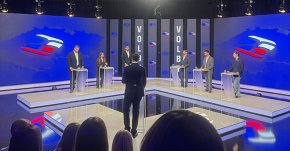 Co divák doma nevidí. Studenti MUP usedli do publika Zuperdebaty na CNN Prima News
9. 10. 2026 Autor: Barbora Vošahlíková
Jedinečnou příležitost nahlédnout do televizního vysílání z bezprostřední blízkosti dostali studenti Metropolitní univerzity Praha. Ve středu 30. září se na pozvání CNN Prima NEWS zúčastnili jako publikum předvolební Zuperdebaty, ve které se utkali mladí političtí kandidáti do 30 let, tedy zástupci generace Z.
Co divák doma nevidí. Studenti MUP usedli do publika Zuperdebaty na CNN Prima News
9. 10. 2026 Autor: Barbora Vošahlíková
Jedinečnou příležitost nahlédnout do televizního vysílání z bezprostřední blízkosti dostali studenti Metropolitní univerzity Praha. Ve středu 30. září se na pozvání CNN Prima NEWS zúčastnili jako publikum předvolební Zuperdebaty, ve které se utkali mladí političtí kandidáti do 30 let, tedy zástupci generace Z.
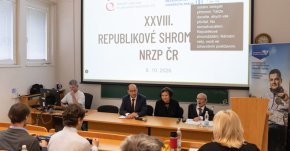 Metropolitní univerzita Praha hostí 28. republikové shromáždění NRZP ČR
8. 10. 2026 Autor: redakce
Je nám potěšením, že Metropolitní univerzita Praha spolupořádá ve svých prostorách 28. republikové shromáždění Národní rady osob se zdravotním postižením ČR (NRZP ČR).
Metropolitní univerzita Praha hostí 28. republikové shromáždění NRZP ČR
8. 10. 2026 Autor: redakce
Je nám potěšením, že Metropolitní univerzita Praha spolupořádá ve svých prostorách 28. republikové shromáždění Národní rady osob se zdravotním postižením ČR (NRZP ČR).
 Studenti MUP s Miss World a příšerkami vyráží do škol zlepšit finanční gramotnost
7. 10. 2026 Autor: Dominik Stroukal
Jak zábavnou formou přiblížit dětem a mladým lidem svět financí? O to se snaží vzdělávací aplikace Money Monsters, za kterou stojí ekonom a garant studijního programu Digitální ekonomika na MUP dr. Dominik Stroukal a Miss World Krystyna Pyszková.
Studenti MUP s Miss World a příšerkami vyráží do škol zlepšit finanční gramotnost
7. 10. 2026 Autor: Dominik Stroukal
Jak zábavnou formou přiblížit dětem a mladým lidem svět financí? O to se snaží vzdělávací aplikace Money Monsters, za kterou stojí ekonom a garant studijního programu Digitální ekonomika na MUP dr. Dominik Stroukal a Miss World Krystyna Pyszková.